National Center for Campus Public Safety
Marketing & Communications Lead
Engagement Overview
From NCCPS's founding in 2013 through its closure in 2019, I served as the Center's communications consultant, leading media relations, public-facing publications, and executive communications for this bipartisan, federally-funded national clearinghouse on campus public safety. I was named directly in NCCPS's founding federal grant, to secure dedicated funding for the communications role itself, but I held the position as an outside consultant throughout. I owned the full communications function for NCCPS, across every channel the Center used to reach the field: media relations and executive communications, including press strategy and talking points for the Director on often-divisive policy topics; a weekly newsletter; all of the Center's social media, which I set up and ran from the ground up; and email marketing to drive registration for a monthly webinar series. In practice, this meant translating complex research and programming into communications that ranged from carefully neutral policy messaging to recurring editorial content to straightforward program and event promotion — a wide enough range that strategy and day-to-day execution were both mine to own.
Featured Project
Campus Carry: from convened research to public communications
The Through Line
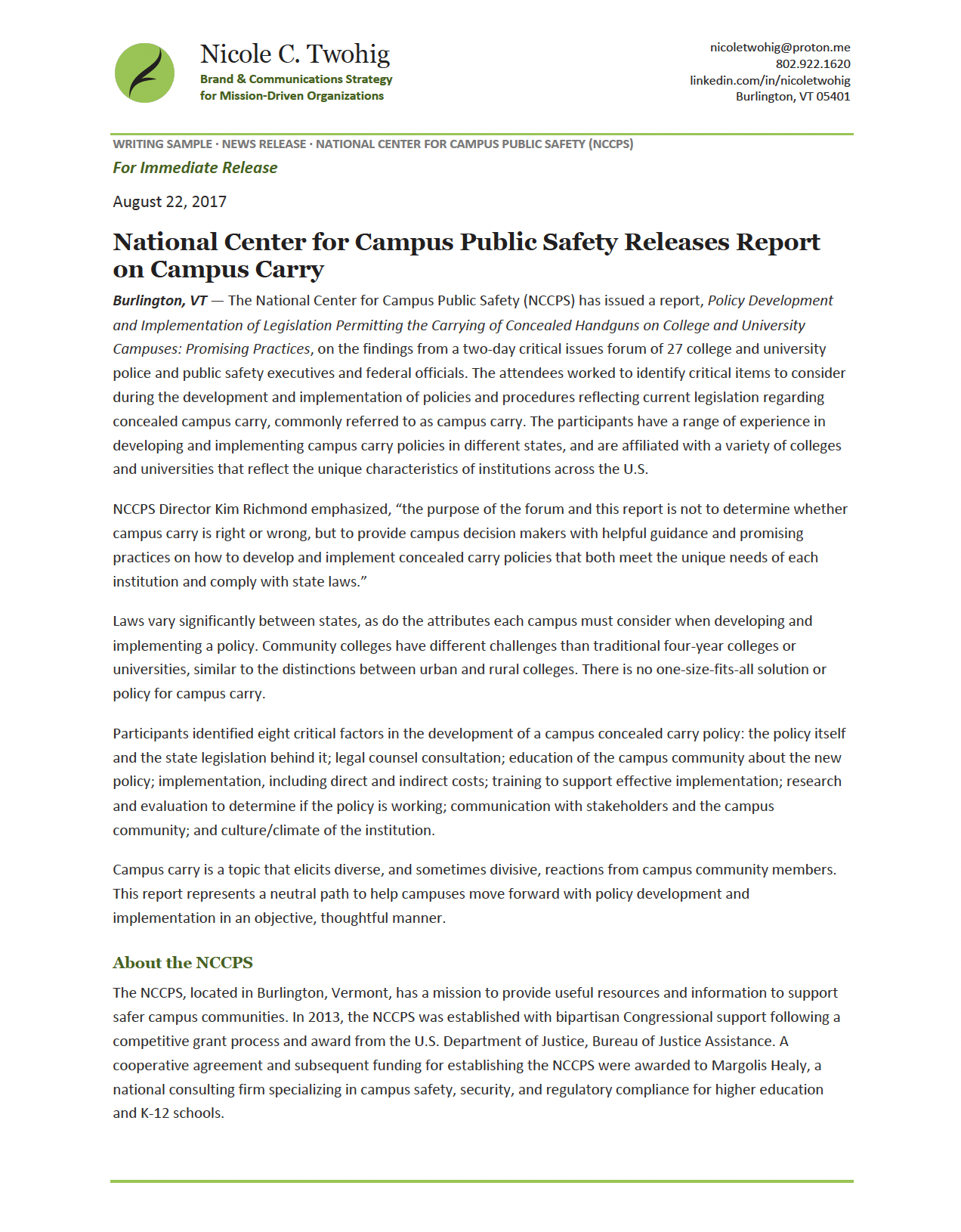
As concealed-carry legislation expanded to more states' college and university campuses, campus safety officials brought their questions to NCCPS for guidance. NCCPS responded by convening a two-day forum, which resulted in a a formal 46-page policy report — Policy Development and Implementation of Legislation Permitting the Carrying of Concealed Handguns on College and University Campuses: Promising Practices (June 2017). The report identified eight critical factors for institutions developing a campus carry policy: Policy, Legal, Education, Implementation, Training, Research and Evaluation, Communication, and Culture/Climate.
Although I wasn't the report's author, I owned everything that turned that research into public communication including the official news release announcing it, and press-ready talking points for NCCPS Director Kim Richmond to use in trade-press interviews on the report's findings.
Campus Carry: The Communications Challenge
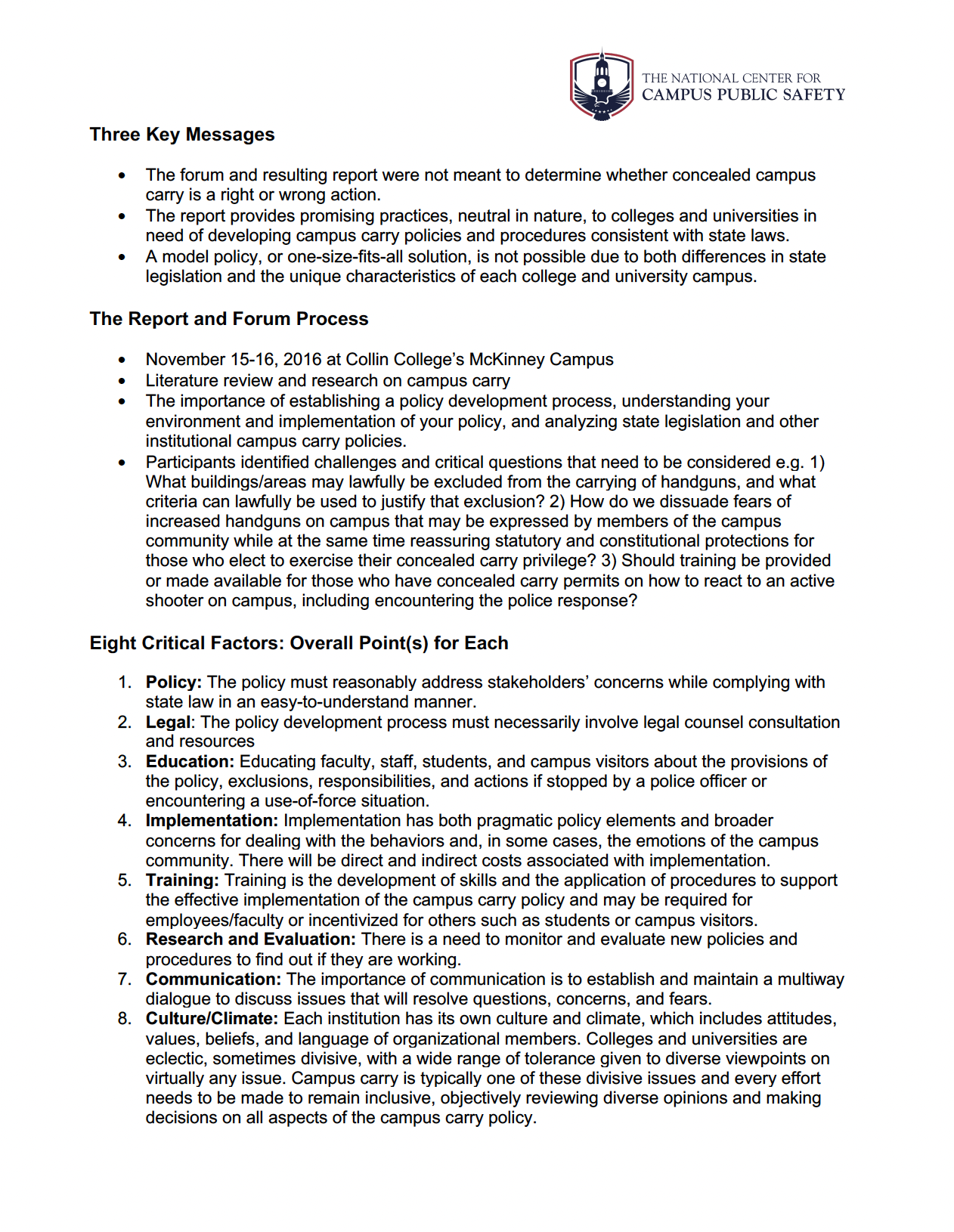
The difficulty wasn't explaining the report; it was holding NCCPS's neutral, non-advocacy position on a genuinely divisive topic, consistently, across every format. That meant establishing a message architecture upfront (three key messages, a plain-English summary of the forum/report process, and one-line framing for each of the eight critical factors) that could flow consistently into a news release, talking points for the Director handling trade-press interviews with pointed, politically loaded questions (e.g., whether campus carry was "the proper response" to mass shootings, how deterrence research factored in, how a federal court ruling on a university's gun ban should be read), or into any other person's remarks in the field. This all needed to happen without NCCPS ever taking a position on the underlying legislation, which was explicitly outside its mandate as a federally-funded Center.
Virtual Professional Development
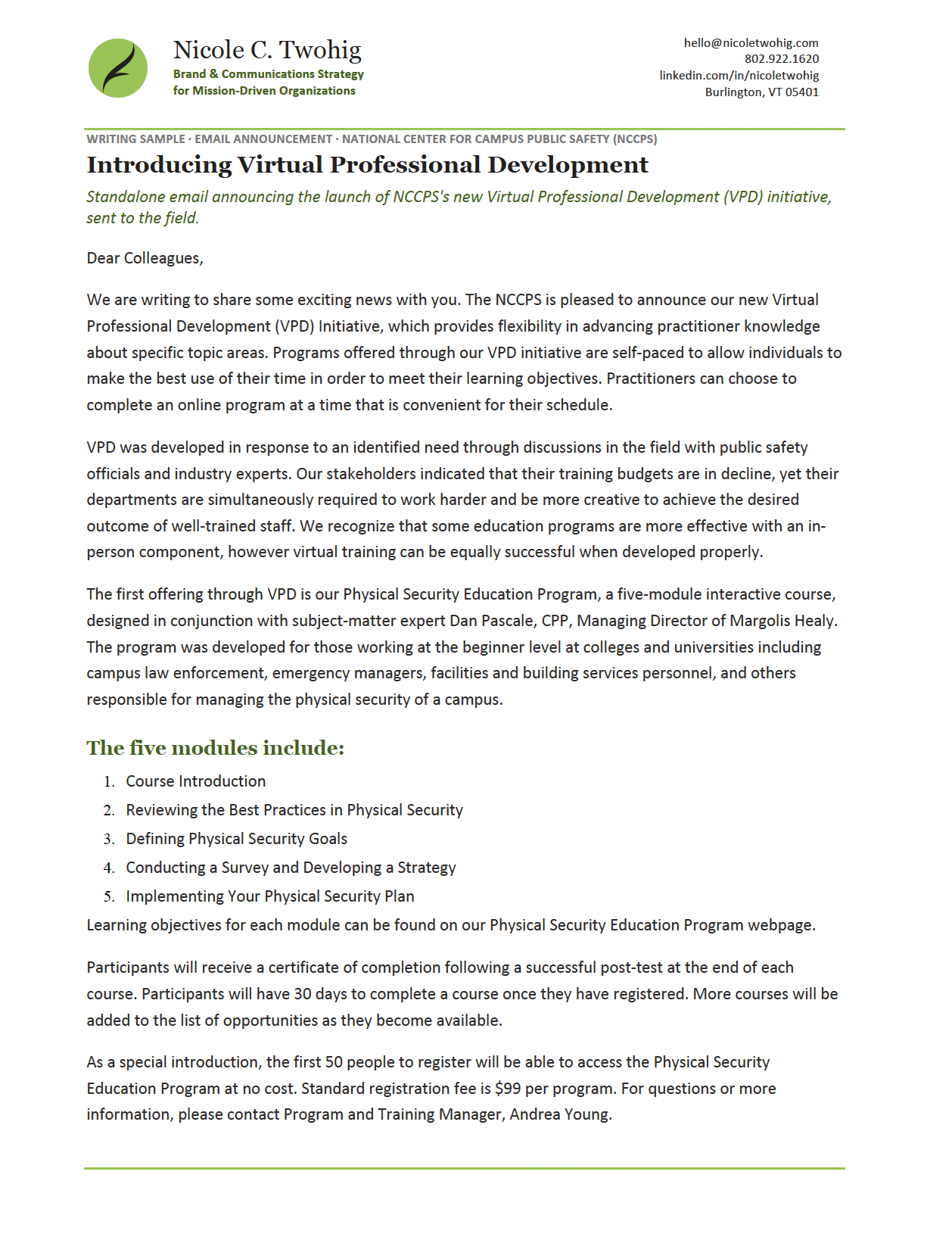
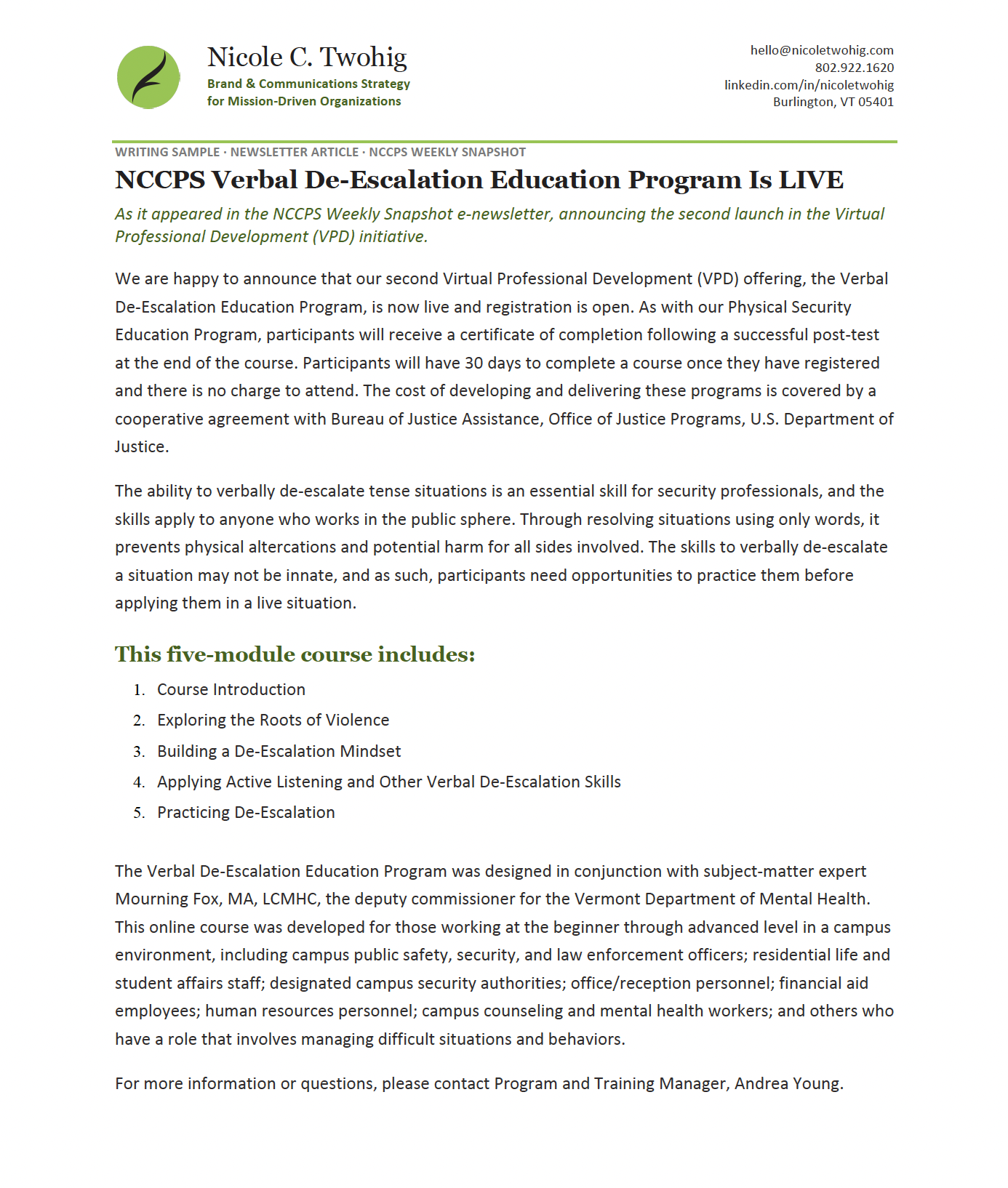
NCCPS launched a Virtual Professional Development initiative to meet a need the field itself identified: training budgets were shrinking even as departments were asked to do more, and self-paced online learning could fill the gap where in-person training wasn't feasible. I wrote the initiative's launch email blast and an e-newsletter announcement when the second offering was released.
Trauma-Informed Sexual Assault Investigation & Adjudication Program: conference marketing and scaled national media strategy
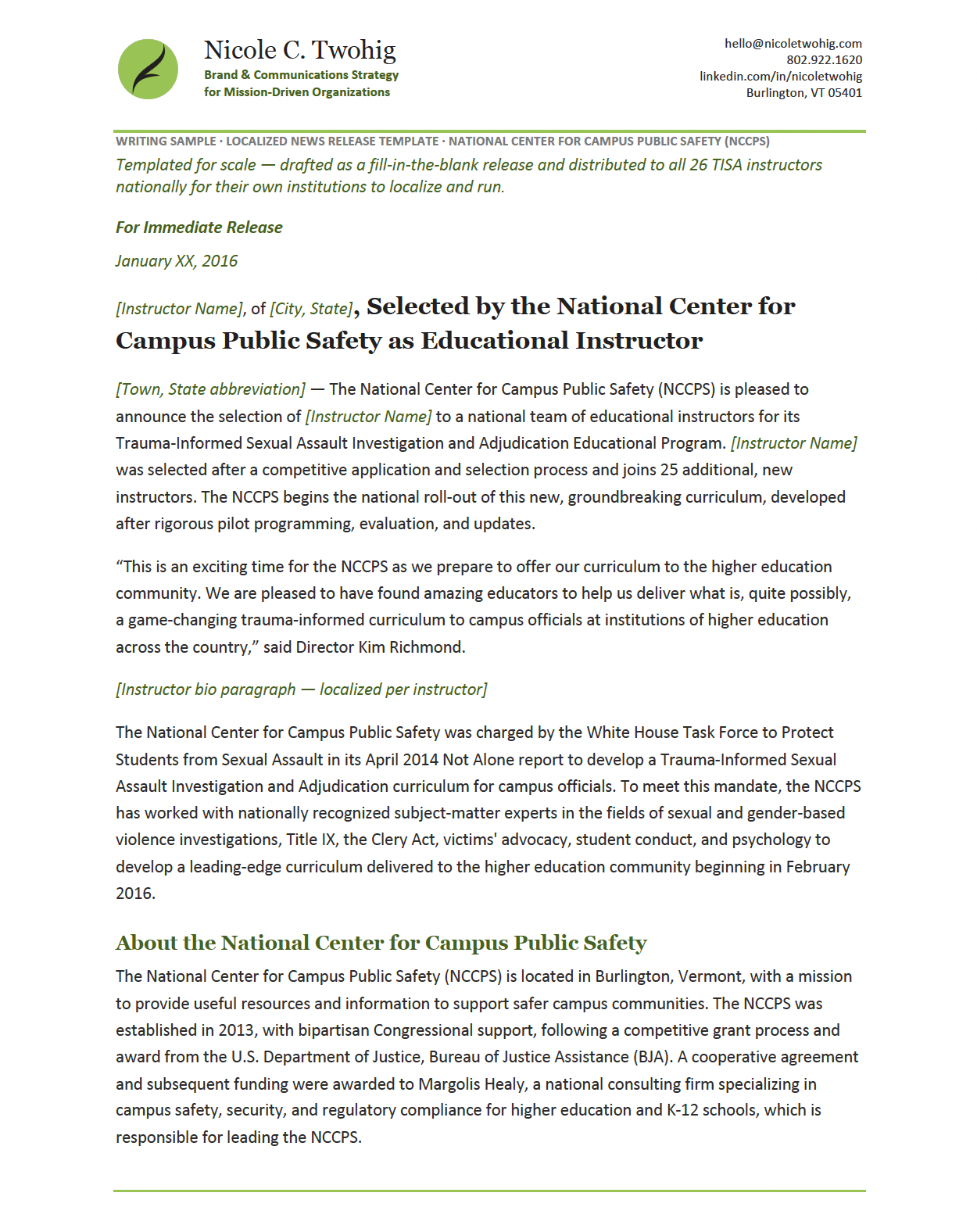
The White House Task Force to Protect Students from Sexual Assault's 2014 Not Alone report charged NCCPS with developing a trauma-informed investigation and adjudication curriculum for campus officials. This included training 26 curriculum instructors who could deliver the curriculum nationwide. I wrote the general announcement release, and drafted a fill-in-the-blank localized version of the release (headline, dateline, and bio paragraph templated for each instructor's name, city, and background) and distributed it to all 26 instructors for their own institutions to run. It worked three times over and counting.
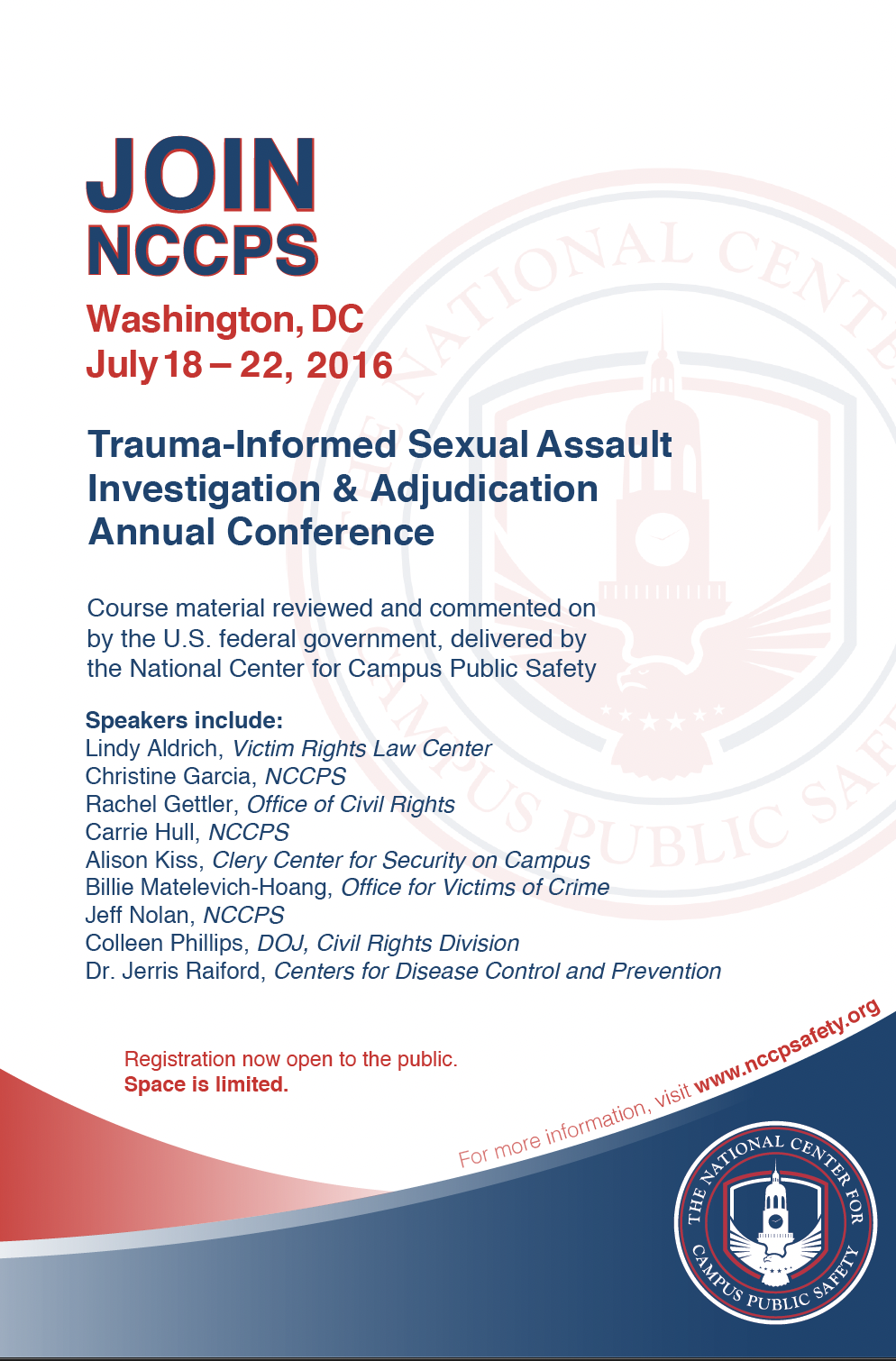
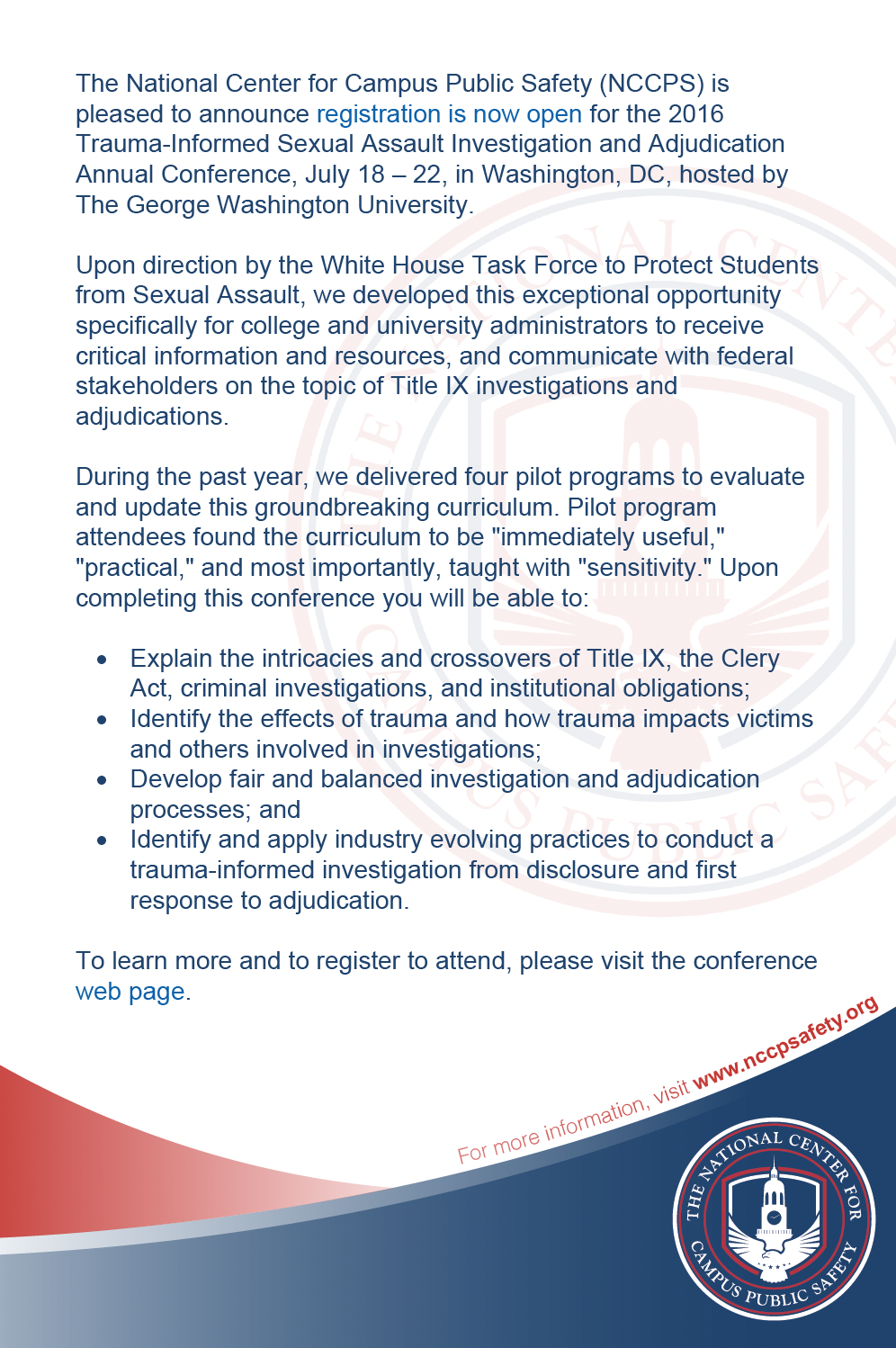
Following the appointment of instructors, NCCPS began holding national and regional conferences to train campus officials on the new curriculum. The first national conference was held in Washington, DC in July 2016. The flyer was used with external partners and our own subscriber network to build attendance. Notable for the speaker roster alone: representatives from the DOJ Civil Rights Division, the CDC, the Office for Victims of Crime, the Office of Civil Rights, and the Clery Center, among others is proof of the convening power this work required. Design template was created by our design partner, marketing copy was my responsibility.